
Explore this topic: ESA basics and animal comparisons
The best ESA move-in checklist starts weeks before the truck arrives: confirm which rules protect you where you are moving, send your accommodation request in writing, get your paperwork and your animal’s records in order, and do not bring the animal in until the housing provider or school has said yes. This page walks through each step for renters and dorm students, in the order you will need them.
One thing changed in 2026 and it affects your planning. In May, HUD said it would stop accepting federal complaints about emotional support animals that are not individually trained, so state and local protections now matter more than before. We explain that below, then the checklist.
TL;DR
- Start at least 60 days before move-in when you can. Many universities ask for that lead time, and a late request can delay approval.
- Put your request in writing and keep copies of everything, even though the law does not always require writing.
- Bring a letter from a licensed clinician who treats you. Online “registrations,” certificates and ID cards do not prove a need.
- Gather your animal’s records: vaccinations, spay/neuter proof, vet details and an emergency contact.
- Wait for written approval before the animal enters the home or residence hall, then set up the space before day one.
Table of Contents
- What changed in 2026, and why it matters for your move
- Step 1: Know which rules apply to your new home
- Step 2: Start early and send the request in writing
- Step 3: Get the right documentation
- Step 4: Assemble your animal’s records
- Step 5: Wait for written approval
- Step 6: Clarify the rules and any fees
- Step 7: Prepare the space and your animal
- If your request is denied
- Our perspective
- Where to read next
- FAQ
- Sources
What changed in 2026, and why it matters for your move
For years, the federal Fair Housing Act was understood to cover two kinds of assistance animals: trained service animals and other animals, trained or not, that give therapeutic emotional support. HUD’s own notice, reproduced in UNC School of Government course materials, described both.
On May 22, 2026, HUD issued new enforcement guidance. According to the National Association of Realtors’ summary, it rescinds HUD’s 2020 statement and says the agency will no longer accept complaints from people whose animals are not individually trained to do work or tasks related to a disability. The disability-rights group DREDF describes the same memo as ending federal enforcement for untrained emotional support animals.
What this means for you in practice:
- Federal complaints are harder. If a landlord refuses an untrained ESA, HUD may not take the complaint.
- State and local law still counts. California’s Civil Rights Department, for example, said in a July 2026 Legal Alert that under state law a support animal does not have to be trained to perform tasks. Rules differ by state, so look up your state’s civil rights or fair housing agency before you move.
- Schools set their own policies. Colleges and universities have written ESA procedures, and those are what you follow in a dorm.
For a fuller walkthrough, see our guide to ESA housing rights in 2026 and our explainer on how the Fair Housing Act change affects renters.
Step 1: Know which rules apply to your new home
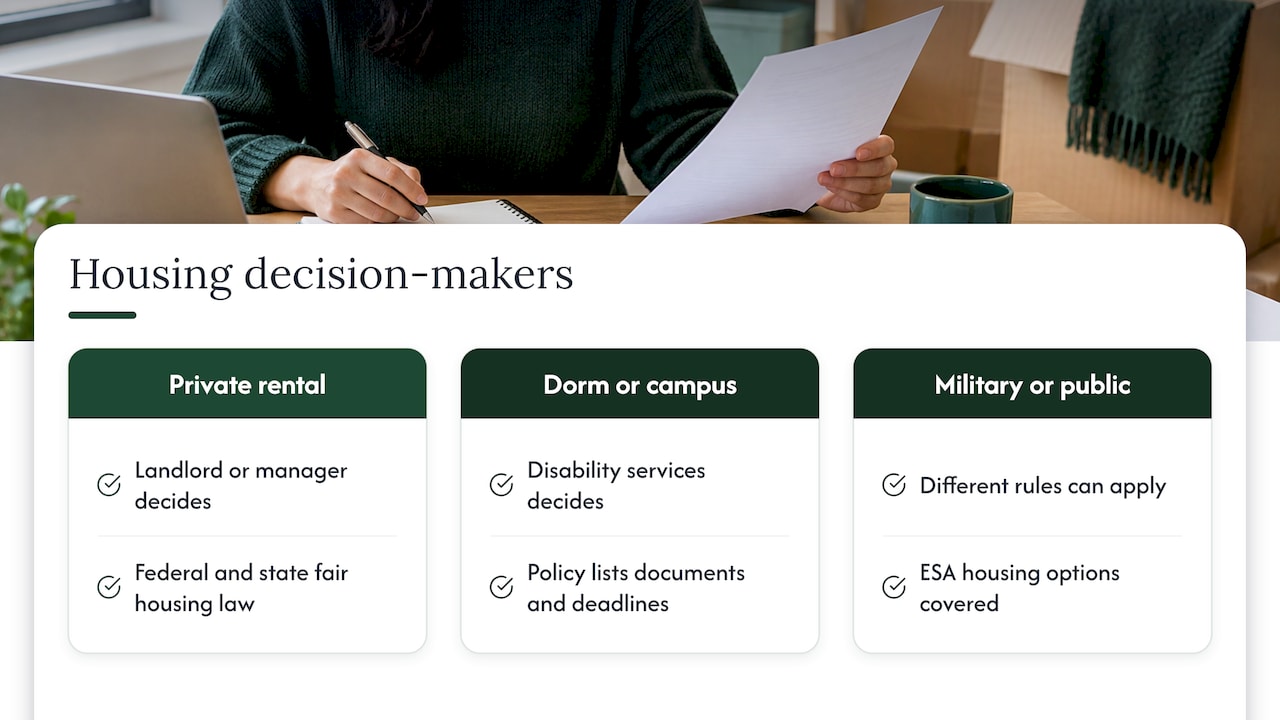
Before anything else, work out who decides your request.
Private rental. Your landlord or property manager decides, under federal and state fair housing law. Find your state’s fair housing agency and read what it says about assistance or support animals.
Dorm or campus apartment. The disability services office, sometimes called accessibility or student disability services, decides. Their policy is public and usually spells out every document and deadline.
Military or public housing. Different rules can apply. Our page on ESAs in military housing covers the options.
Two quick points on terms. An ESA is an animal that gives comfort and companionship that eases symptoms of a mental health condition; unlike a service dog it needs no task training under most state and school policies. A reasonable accommodation is an exception to a rule, such as a no-pets policy, that a housing provider makes because of a disability.
Step 2: Start early and send the request in writing
Timing is where most dorm students trip up. Several schools publish the same advice:
- UMass Amherst advises submitting the request and documentation as early as possible, ideally at least 60 days before move-in.
- Cal State Fullerton’s policy says requests submitted fewer than 60 days before move-in may limit the university’s ability to put the accommodation in place.
- Yeshiva University’s policy, updated in August 2026, advises sending the request and provider verification form with the housing application, with at least 60 days’ notice. It also says its disability office generally tells students within 7 business days if documents are insufficient.
Renters usually have less formal timelines, but the same logic holds: ask before you sign the lease or at least before you move the animal in.
On format, rules differ. The New Jersey Attorney General’s fact sheet says a housing provider cannot require a request to be in writing or in a specific format. Even so, Disability Rights California advises sending it in writing and keeping a copy, because that protects you if there is a dispute about when you asked.
A good written request is short:
- Your name, the address or unit, and your planned move-in date.
- A statement that you have a disability-related need for an emotional support animal and are requesting a reasonable accommodation to your pet policy.
- The type of animal, and a note that your clinician’s letter is attached.
- A request for a written reply.
Send it by email or a method that leaves a date stamp. Save the sent message.
Step 3: Get the right documentation
If your disability or need is not obvious, a housing provider may ask for documentation. The California Civil Rights Department FAQ says they may, but are not required to, and that you need only disclose enough to document the disability-related need, not your diagnosis. The New Hampshire Human Rights Commission adds that if a disability is visible, a landlord cannot request documentation at all.
What a valid letter looks like
The letter should come from a licensed health care professional who actually treats you. Central Wyoming College’s 2025 policy asks for a current prescription from a licensed provider with an ongoing treatment relationship, not a one-time purchased verification. Cal State Fullerton asks for a licensed third party in California who maintains a therapeutic relationship with the student.
The New Jersey fact sheet says internet documentation that does not come from a treating professional generally is not reliable enough.
What you do not need
There is no legal requirement to register or certify an ESA, according to the California Civil Rights Department, and vests, tags, ID cards and certificates do not reliably establish a disability or need. UNH Student Accessibility Services says the same about online registrations: they are not appropriate documentation. If a site is selling you a registry number, read our piece on whether ESA registration is real before you pay.
If you do not yet have a letter and need one, you can read how to qualify in our ESA letter guide.
Step 4: Assemble your animal’s records
Dorms are the strictest, but a landlord may ask for similar basics. Here is what schools in our research ask for, so you can build a folder in advance:
| Item | Example from a published policy |
|---|---|
| Age and training status | UMass: dogs at least 12 months old and house-trained, cats at least 6 months |
| Vaccinations | UMass: current rabies plus species-specific vaccines (FVRCP and FeLV for cats, DHLPP for dogs) |
| Spay/neuter proof | UMass, Denver, Central Wyoming College |
| Veterinary care | UMass: proof of ongoing veterinary care; CWC: a veterinary exam record |
| Emergency contact | UMass: someone off campus who can remove the animal within 6 hours; CWC: within 12 hours |
| Signed agreement | UMass Animals in Residence Agreement; Denver ESA Resident Agreement |
The University of Denver’s 2026-2027 residence guide also lists city or county registration where applicable and a recent photo of the animal. Names of forms and ages vary, so read your own school’s page rather than assuming.
Name your emergency contact now. It has to be a real person who agrees in advance, lives off campus and can show up on short notice.
Step 5: Wait for written approval
This is the step people try to skip, and it causes the worst outcomes. Cal State Fullerton says unauthorized animals may not be kept in student housing before a request has been reviewed and approved. Yeshiva’s policy says the same and adds that unauthorized animals are removed at the student’s expense. UMass and UNH both require approval and a signed housing agreement before the animal comes to campus.
Ask for the decision in writing, and keep it with your lease or housing contract. If your plan was to move the animal in alongside you on day one, build in time for approval first.
Step 6: Clarify the rules and any fees
Before you move in, read the written terms and ask about anything unclear:
- Number of animals. Cal State Fullerton generally permits one approved ESA per residential unit, and Central Wyoming College allows one per student in most cases. If you have two or three animals, say so in your request and ask for each one to be considered, with your clinician’s letter explaining the need. Expect more scrutiny than for a single animal, and expect a school to apply its own cap.
- Common areas. Denver limits ESAs to the assigned room or apartment, with common areas used only as needed for exercise or relief. Fullerton requires a carrier or a leash no longer than six feet outside the living space.
- Annual renewal. Fullerton requires evidence of continued need and current vaccination and health records every academic year. Put the date on your calendar.
- Fees. Many people ask whether a pet deposit applies. Our guide on ESA pet fees covers what renters can push back on, and our no-pets policy article explains how an ESA request differs from a pet request. Rules vary by state, so confirm yours.
- Insurance. See what HUD said about insurance demands.
Schools also weigh the needs of other residents. Yeshiva notes it balances accommodations against the needs of students with allergies or animal fears, so housing placement can be part of the decision.
Step 7: Prepare the space and your animal
Approval is not the finish line. Animals feel a move too.
App State’s housing office advises assessing your room size, using an appropriately sized crate or enclosure, creating a quiet rest area, setting a daily care schedule, planning for exercise and toileting in bad weather, and finding a local veterinarian. It also notes that a newly adopted animal needs time to bond, so a backup plan is sensible.
A practical packing list:
- Copies of the approval, the agreement and vaccination records, in a folder and on your phone
- Food, bowls, bedding and a crate or carrier
- Leash or litter supplies, plus an enzyme cleaner for accidents
- The contact details of a nearby vet and an emergency clinic
- A familiar blanket or toy for the first nights
Washington State University’s housing policy says an animal may be excluded if it is not housebroken, damages others’ property, poses a direct threat to health or safety, or is not cared for by its handler. Handler control, vaccination, licensing and leash laws all apply. Treat those as your house rules.
Leave the old place clean
If you are leaving a rental, your deposit may depend on how you leave it. A move-out cleaning checklist helps you cover carpets, tile and appliances so the transition is smooth on both ends.
If your request is denied
Denials happen for stated reasons. The New Jersey fact sheet says a provider may refuse if the animal would fundamentally alter its operations or impose an undue financial or administrative burden. Schools may cite a direct threat, damage or lack of care, as in the WSU list above. Missing or unreliable documents are another common cause.
What to do next:
- Ask for the reason in writing.
- Fix what is fixable: a letter from your own treating clinician, missing vet records, a clearer request.
- Resubmit and keep the dates.
- Contact your state or local fair housing agency, or Disability Rights California if you are in California. Because of the 2026 HUD change, state agencies are the likelier route.
Our perspective
Most of the trouble we hear about at move-in has one root: people buy a certificate or registration and assume it settles the question. It does not. What housing providers and schools actually respond to is a request made early, a letter from a licensed clinician who knows you, and a folder of records that answers their questions before they ask.
We built Supportpet to give plain-language, free information on exactly that, without selling registrations or ID cards. The 2026 HUD change makes it more important to know your state’s rules, your school’s policy and your own paperwork. The checklist above is how we would prepare a friend: ask early, write it down, keep copies, wait for the yes, then make a calm home for your animal.
Erik
Where to read next
If you are still working out your rights or how to qualify, our free guides are the place to begin. The Supportpet housing guide pulls together the federal and state picture in plain language, and our article on making a dog an emotional support animal without registries or pet fees shows the process from the start.
FAQ
Do you need an ESA letter for housing?
If your need is not obvious, a housing provider or school may ask for documentation, and a letter from a licensed clinician who treats you is the standard form. Online registrations, certificates and ID cards are not accepted as proof by agencies such as the California Civil Rights Department. Schools often also have their own forms.
Can I get an ESA for three cats?
There is no source we found that sets a universal cap for private rentals, but each animal has to be tied to your disability-related need and considered on its own. Some schools allow only one per student or unit, so state the number up front and ask your clinician to explain the need for each.
Is it hard to get approved for an ESA?
Approval mostly depends on a complete, timely request. Send it early, include a letter from your treating clinician, and attach your animal’s vaccination and vet records. Incomplete paperwork is a common reason for delay.
Why would an ESA request be denied?
Common reasons include unreliable or missing documentation, an animal that is not housebroken, a direct threat to health or safety, property damage, or an undue burden on the housing provider. Ask for the reason in writing and correct what you can before resubmitting.
Sources
- HUD Issues New Emotional Support Animal Guidance (NAR)
- HUD’s ESA Policy Reversal (DREDF)
- Special Topics 4 (UNC School of Government)
- California Civil Rights Department Legal Alert, July 2026
- California Civil Rights Department ESA FAQ
- Emotional Support Animals in Housing (New Jersey Attorney General)
- Service & Emotional Support Animals (New Hampshire Human Rights Commission)
- Assistance Animals in Housing (Disability Rights California)
- UMass Amherst Disability Services
- Cal State Fullerton ESA Housing Policy
- Yeshiva University ESA Policy
- UNH Student Accessibility Services
- Central Wyoming College ESA Policy
- University of Denver Guide to Residence Living 2026-2027
- App State Planning for an Assistance Animal
- Washington State University Service and Support Animals
- Move-out cleaning checklist
Recommended
- ESA Documentation Checklist: What to Gather Before You Submit
- ESA Housing Paperwork: What to Prepare and Send
- Get Your ESA Approved: Copy Ready Letter to Notify Your Landlord
- How to Transfer an ESA Letter When You Move or Change Housing