
Explore this topic: ESA letters and documentation
To live with an emotional support animal (ESA) in a dorm, you need a letter from a licensed clinician who treats you, a request filed with your school’s disability office, and animal paperwork such as vaccination records. A certificate or registration bought online is not what colleges look for. Each school sets its own forms and deadlines, so the fastest route is to learn what every school asks for, then match it to your school’s page.
TL;DR
- Colleges treat an ESA as a housing accommodation under the federal Fair Housing Act. The request goes through the disability or accessibility office, not through housing alone.
- The core document is a letter from a licensed professional who knows you. It should describe a disability, explain how the animal helps, and name the species.
- After approval, expect a second set of papers about the animal: vaccines, spay or neuter proof, an emergency contact and a signed agreement.
- Apply early. Review can take from a few business days to several weeks, and approvals usually are not retroactive.
- Online registrations, ID cards and certificates do not establish need.
Table of Contents
- Why a dorm asks for documentation at all
- The clinician letter: what it has to establish
- Paperwork about the animal
- How the request usually runs, step by step
- When to apply
- What does not count as documentation
- Rules once your ESA is approved
- What if you keep an animal without approval
- Our perspective
- Where to start
- FAQ
- Sources
Why a dorm asks for documentation at all
An ESA is not a pet in the eyes of a housing office, and it is not a service animal either. Stanford’s Office of Accessible Education, for example, explains that support animals are not service animals under the ADA and are approved as a residential accommodation only. That is why the request looks like a disability accommodation request rather than a pet application. If you want the full contrast between the two categories, our ESA vs. service dog guide lays it out.
The legal frame is the Fair Housing Act. Washington State University states that a student may keep an ESA in university housing as a reasonable accommodation when the student is disabled, has documentation from a qualified provider, and the animal is necessary for equal use of the dwelling. The same page requires an identifiable relationship between the impairment and what the animal does for you. In plain terms: the school is not asking whether you love your animal. It is asking whether your disability and the animal are connected.
If you want the federal test in more detail, see our guide to the two things federal housing law requires for ESA approval.
The clinician letter: what it has to establish
The letter is the center of your file. Schools publish their own criteria, and they overlap a lot. Four published examples show the pattern.
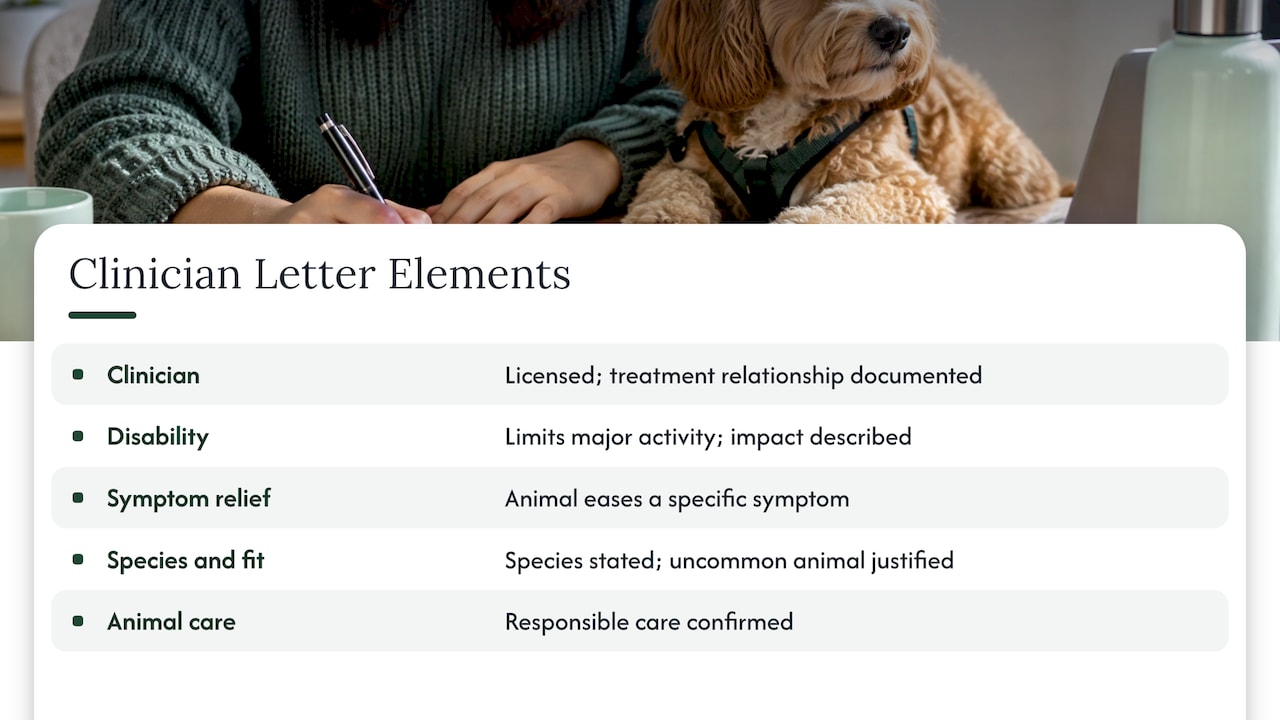
Boston University asks for a letter on professional letterhead with the clinician’s name, title, organization and address, ideally with license and contact details. It should be dated, indicate an ongoing treatment relationship, state whether the condition substantially limits a major life activity, and connect the animal to your symptoms. It should also state the species, with a justification if the animal is uncommon.
UMass Amherst wants a licensed clinician, such as a psychologist, psychiatrist or licensed clinical social worker, to establish a mental health disability, describe how it affects daily functioning, and explain how the animal eases that impact for you specifically.
TCU lists five points its letter must verify: a disability that substantially limits a major life activity, the clinician’s relationship with you and the date of last consultation, that the animal is needed to ease a symptom, that you can care for it responsibly, and whether the animal was specifically prescribed.
Ithaca College requires a licensed professional and the length of the therapeutic relationship, a formal diagnosis at the ADA disability level, functional limitations, and why the animal fits your treatment plan.
A checklist built from those policies
Before you send anything, check that the letter:
- Comes from a licensed professional who has actually treated you, not someone who only reviewed a form.
- Is on letterhead, signed and dated. Some schools prefer a recent date; Eastern Maine Community College, for instance, prefers a letter dated within the prior six months.
- States how long the clinician has known you.
- Says you have a disability that limits a major life activity, such as sleeping, concentrating, or interacting with others.
- Links the animal to your symptoms, in your own situation, not in general terms.
- Names the species and, where the school asks, whether it was specifically recommended.
A letter that only says “my patient would benefit from an animal” tends to fall short. Ithaca’s criteria draw the line clearly: a housing accommodation can be preferred or helpful without meeting the legal standard of need. The letter has to speak to need.
To see how those elements look on the page, read our ESA letter sample and the three sample templates that pass HUD checks.
Helping your clinician help you
Clinicians write stronger letters when they have your history in front of them. Gathering your treatment dates, diagnoses and notes on how symptoms affect your classes, sleep and daily routine makes the conversation faster. A guide on gathering medical records for a disability claim explains how to collect and organize the information that shows diagnosis, functional impact and treatment. Your school generally asks the clinician for a statement about these points rather than your full chart, so share records with your clinician and let them decide what goes in the letter.
Paperwork about the animal
Approval of your disability-related need is only the first gate. Most schools then ask about the animal itself.
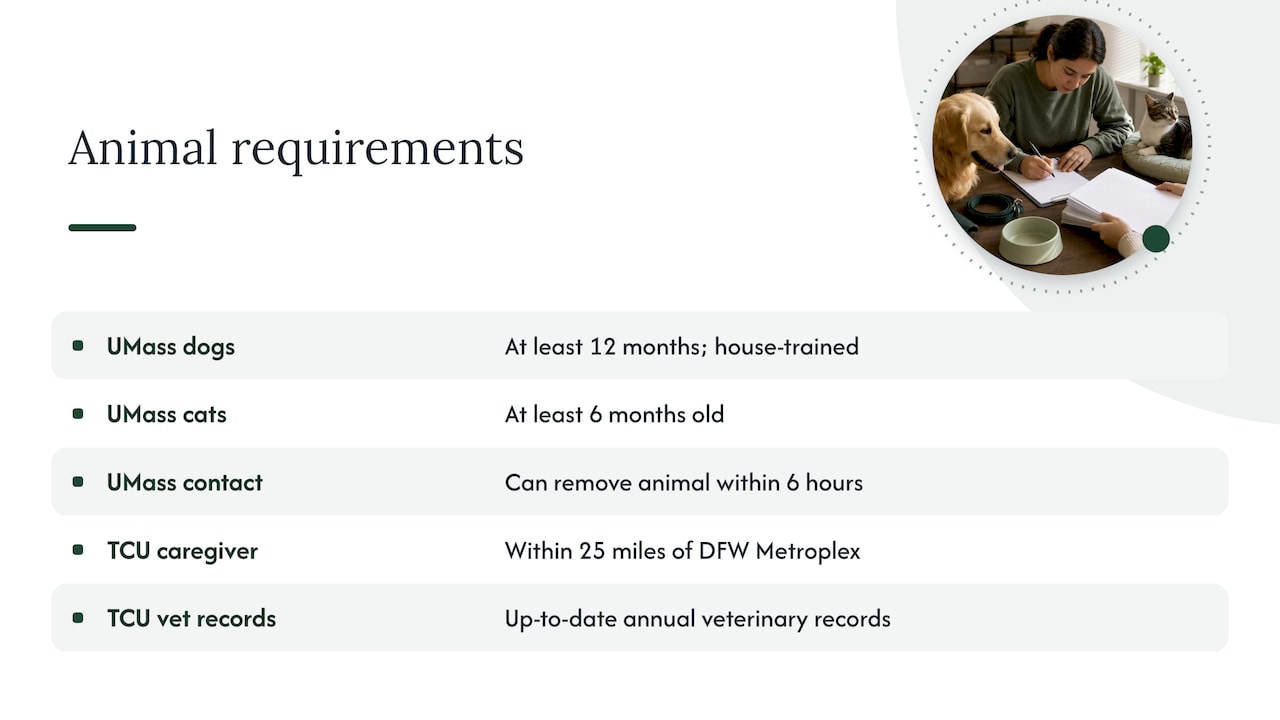
UMass Amherst requires, after approval, that dogs be at least 12 months old and house-trained, and cats at least 6 months old. It also asks for proof of ongoing veterinary care, spay or neuter, and current vaccinations, an emergency contact who is not a UMass student in campus housing and can remove the animal within 6 hours, and a signed Residence Agreement Contract.
TCU asks for up-to-date annual veterinary records, spay or neuter verification, a photo, an alternate caregiver within 25 miles of the DFW Metroplex who does not live in TCU housing, a Fort Worth pet license or microchip, and a signed Owner Statement and Agreement before the animal may enter housing.
Some schools add a vet’s statement. Eastern Maine Community College asks for a veterinarian’s statement on the animal’s health and suitability for confined communal living, plus a student agreement letter.
Book the vet visit early. Vaccine series for a young animal take time, and a missing record is one of the easiest ways to stall an approved request. Our ESA vaccination requirements guide explains what owners typically need to have on file.
How the request usually runs, step by step
The details vary, but the sequence is consistent across schools.
1. Register with the disability office
Almost every school starts here. St. John’s University, for example, requires students to register with its disability office, complete a form with a release of information, and have the evaluator complete a second part. The release lets the office talk to your clinician if something is unclear.
Eastern Illinois University points out that it is the student’s responsibility to self-identify and request. Nobody will start the process for you.
2. Submit the clinician letter and any school form
Some schools accept a free-form letter that covers their checklist. Others hand your clinician a form. Check which your school uses before your appointment, so the clinician writes it once.
3. Mark the request on your housing application
This step is easy to miss. At the University of Hawaii Hilo, students must indicate the ESA request on the housing application, and housing grants only a provisional accommodation until formal notice arrives by a set date, after which it is rescinded. Read your school’s version of this rule carefully.
4. Wait for the review
Review times differ. Eastern Illinois says processing may take up to four weeks. Cal State Fullerton lists approval as typically taking 5 to 15 business days. If a school asks for more information, answer quickly: delays usually come from incomplete files.
5. Complete the housing steps
Approval by the disability office does not mean the animal can move in. At Cal State Fullerton, the later steps include uploading a photo and vaccination records, housing contacting roommates about allergies or objections, meeting a community coordinator, all roommates signing an agreement, and final clearance from Housing before move-in. Expect to coordinate with your roommates in a shared room or suite.
6. If you are denied
TCU’s policy lets a student appeal, and it states that documentation is kept confidential and separate from the academic record. Ask your school for its appeal route in writing and bring a revised letter if the denial named a gap.
When to apply
Treat the deadline on your school’s page as the real date and aim to be well ahead of it. The pattern across schools is that fall requests are due in spring or summer. St. John’s, for instance, sets separate deadlines for returning and incoming students, and late forms may be affected by limited housing space. Eastern Maine uses separate deadlines for fall, spring and summer terms, and Eastern Illinois begins reviewing future-semester requests on a set date each term.
There is also a reason beyond deadlines. Eastern Illinois notes that accommodations are not retroactive and apply only from the date of approval. Starting early gives you room for a vet visit, a clinician appointment and a possible follow-up request. Check your school’s disability office page for the current schedule, since dates shift year to year.
What does not count as documentation
The results on this keyword are crowded with sites that sell certificates, ID cards and “registrations.” There is no official ESA registry. Ithaca College says outright that websites selling certificates, registrations and licensing documents are not sufficient to reliably establish need. A vest, a card or a number does not replace a clinician who knows you.
States are tightening the rules around the clinician too. Minnesota’s statute, for example, excludes from “licensed professional” anyone who operates primarily to provide animal certification. That law covers rental housing generally, not dorms specifically, but it shows where the rules are heading: the letter has to come from a real treating relationship. If you are also renting off campus, our ESA housing application checklist covers that side.
Rules once your ESA is approved
Approval comes with conditions. At Southeast Missouri State, an approved ESA is restricted to your room or suite and may not enter common areas, classrooms or other campus buildings without permission, and an $85 annual cleaning charge applies. Policies at other schools differ, so read your signed agreement.
Schools can also evaluate each request case by case. Central Wyoming College says an ESA may be denied as unreasonable if it imposes an undue financial or administrative burden or poses a direct threat to health, safety or property. Clean records, a well-behaved animal and prompt answers to housing staff keep your arrangement stable.
What if you keep an animal without approval
Most housing contracts prohibit pets other than approved animals, and unapproved animals can lead to a conduct or contract violation. The consequences differ by school: some require you to remove the animal, some add fines. Your housing agreement and student handbook say which applies. If you already have an animal with you and a disability-related need, the better path is to contact the disability office right away and start the request. Since approvals are not retroactive, waiting only lengthens the time the animal is unprotected by an accommodation.
Our perspective
Most of the stress we hear about with dorm ESAs comes from one place: students are told that a registration or a certificate is the thing to get, and then a disability office says it is not enough.
What the published policies show is a simple standard. A licensed clinician who knows you describes a disability, the way it limits you, and how the animal helps. Everything else is logistics: vet records, roommate agreements, deadlines.
That is why we focus on explaining the standard in plain language and on exposing the paperwork that looks official but is not. Knowing what a school will actually read lets you walk into your clinician’s office and your disability office prepared.
Erik
Where to start
If you are still sorting out how ESA rules work, our site is built to walk you through it without selling you a certificate or a registration. Start with the Supportpet rights guide for housing protections, how ESA letters work and how to spot scams.
It is free to read, and it is written for students, renters and pet owners who want the rules straight before they spend time or money.
FAQ
Is an emotional support animal a reasonable accommodation in a dorm?
Yes, when you have a disability and the animal is necessary for you to use and enjoy your housing equally. Schools apply the Fair Housing Act and judge each request case by case. They can say no on ordinary grounds, such as a direct threat to safety or an undue burden.
Do I need to register my ESA?
No. There is no official registry, and colleges do not accept purchased registrations or certificates as proof of need. What they look for is a letter from a licensed professional who treats you, plus the school’s own forms and animal records.
Is it hard to get an ESA approved for a dorm?
It is mostly a matter of preparation. The letter must establish a disability and connect the animal to your symptoms, and the file must be complete and early. Incomplete letters and missing vaccine records are common reasons for delays.
What do I need to prove I have an emotional support dog?
Expect a clinician letter, a disability office form, and veterinary records showing vaccinations and spay or neuter status. Schools such as UMass Amherst also set age and house-training minimums for dogs and want an emergency contact who can take the animal quickly.
Sources
- Boston University Disability & Access Services: Emotional Support Animals
- Stanford Office of Accessible Education: Support Animals in Student Housing
- UMass Amherst Disability Services: Emotional Support Animals
- TCU ESA Policies and Procedures
- Ithaca College Student Accessibility Services: ESA documentation criteria
- St. John’s University ESA accommodation request form
- Eastern Maine Community College: Required Documentation
- University of Hawaii Hilo: Emotional Support Animals
- Eastern Illinois University: Requesting Accommodations
- Cal State Fullerton: DSS Housing Accommodations
- Washington State University: Service and Support Animals in Housing
- Southeast Missouri State Resident Handbook
- Central Wyoming College: Emotional Support Animals Policy
- Minnesota Statutes 504B.113
- Gathering medical records for a disability claim
Recommended
- ESA Documentation Checklist: What to Gather Before You Submit
- College Dorm ESA Rules: What Schools Can Require in 2026
- ESA Housing Paperwork: What to Prepare and Send
- Win Campus ESA Appeals: Exact Packet Reviewers Want in 5 Business Days