
Explore this topic: ESA basics and animal comparisons
Most emotional support animal myths come down to one mix-up: treating an ESA like a service dog, or treating a piece of paper like a legal key. An emotional support animal is an animal that gives comfort to a person with a disability. Its protections are narrower than most people assume, and they depend on a licensed clinician’s assessment, not on a registry, a vest or a certificate. (This article is about animals. In the news, “ESA” also stands for education savings accounts, a school funding program in Arizona and other states, which is a different subject.)
Below, each myth is paired with what official and professional sources say, so you know what to rely on in your lease, your dorm application or your travel plans.
TL;DR
- An ESA is a comfort animal for a person with a disability. It is not trained for tasks and does not have the public access rights of a service animal.
- Registries, certificates, ID cards and vests do not create legal status. What matters for housing is documentation of your disability-related need from a licensed professional.
- A letter never guarantees approval. Housing providers review each request individually, and federal and state rules now differ, so check both.
- A clinician cannot certify your pet’s behavior. Caring for the animal and keeping it under control is your responsibility.
- Airlines are no longer required to accept ESAs in the cabin, so check the carrier’s own policy before you book.
Table of Contents
- What an ESA actually is
- Myth 1: An ESA has the same rights as a service dog
- Myth 2: Anyone can get a valid ESA letter instantly online
- Myth 3: You have to register or certify your ESA
- Myth 4: An ESA letter guarantees housing approval
- Myth 5: The federal rules are the same everywhere and never change
- Myth 6: The landlord can charge a pet fee and deposit anyway
- Myth 7: A therapist certifies that your pet is well behaved
- Myth 8: ESA means you can fly with your animal for free
- Myth 9: An ESA is the same as a cure, or the same as therapy
- Quick reference: myth versus fact
- Perspective: why we separate fact from noise
- Where to go next
- FAQ
- Sources
What an ESA actually is
The CDC defines an emotional support animal as an animal that provides emotional support or comfort to a person with a disability. Unlike a service animal, it is not trained to perform disability-related tasks, and it may help simply through companionship. The California Civil Rights Department describes the same idea in its 2026 fair housing FAQ: an animal that provides emotional, cognitive or similar support to help manage the symptoms of a disability.
The American Psychiatric Association notes in its resource document on emotional support animals that the vocabulary is often confused: ESAs, service animals, therapy animals and psychiatric service animals are four different things. Most myths grow out of that confusion, so keep the definition in mind as you read.
Myth 1: An ESA has the same rights as a service dog
Fact: it does not. This is the most common mistake, and the one most likely to get you turned away at a restaurant door.
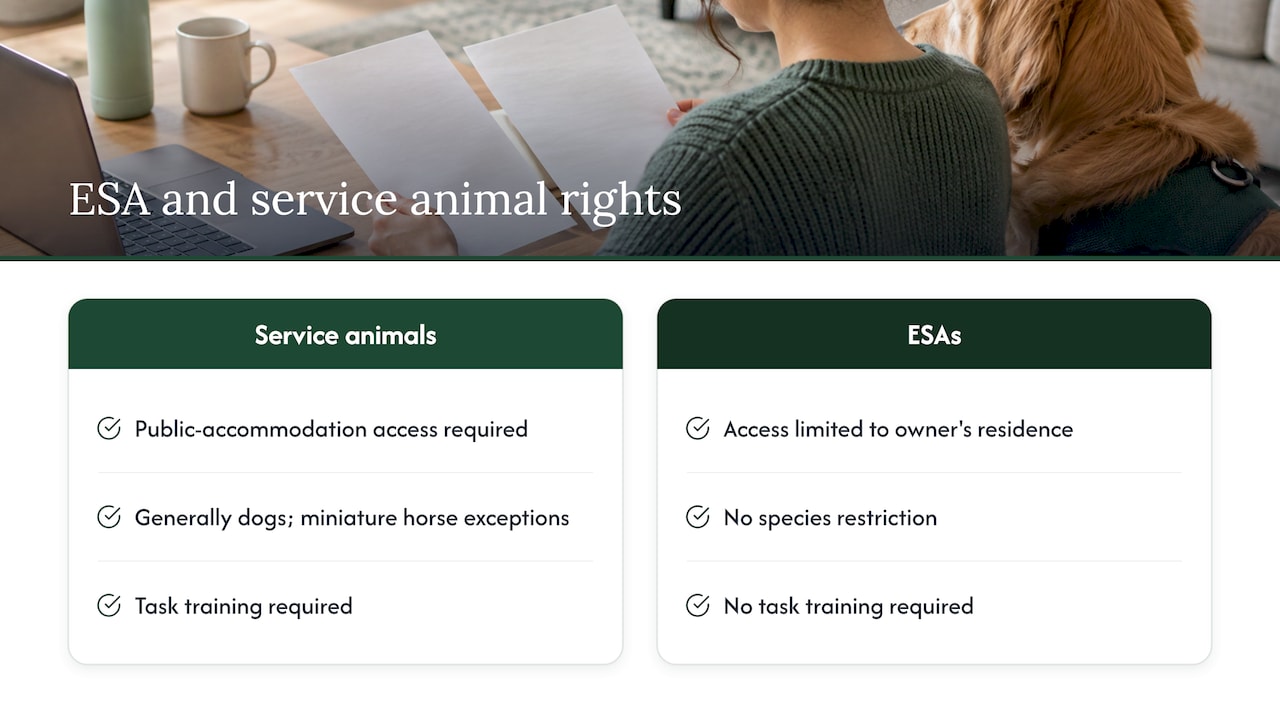
An Indiana disability-rights fact sheet on ESAs explains that service animals must be granted access to public accommodations and programs, while an ESA’s access is limited to the owner’s residence. The same document notes that service animals in the U.S. are generally dogs (with limited exceptions for miniature horses), while an ESA does not have to be a particular species and does not need task training.
The U.S. Department of Justice makes the broader point in its service and assistance animals flyer: which rules apply depends on the setting and the law involved. Housing, public places, schools, transport and workplaces are governed differently. Any blanket claim such as “my ESA can go anywhere” is wrong for that reason.
If you are unsure which category fits your situation, our guide to the differences between an ESA and a service dog walks through training, access and legal basis side by side.
Myth 2: Anyone can get a valid ESA letter instantly online
Fact: a valid letter rests on an individual assessment by a licensed professional.
The warning signs are familiar: a checkout page, a quiz with no human behind it, a promise of same-minute approval. None of that is an assessment. The California Civil Rights Department says that online housing documentation can reliably establish a disability-related need when it is based on an individualized assessment by a licensed health care professional. So the issue is not whether a visit happens online. The issue is whether a real clinician evaluates you.
The American Psychiatric Association’s 2023 guidance for clinicians asked to write ESA letters says a clinician should evaluate the patient’s disability-related need and ability to care for an animal, and that this may take more than one session. A thorough evaluation takes time, which is the opposite of “instant.”
If you already see a therapist, psychiatrist or other licensed provider who knows your history, that relationship is the natural starting point. If you need a new evaluation, a licensed telehealth psychiatric practice, such as one offering a psychiatric evaluation in Arizona, shows what a real clinical process looks like: a licensed clinician, a diagnostic conversation and a care plan, not a form.
To see what a legitimate document contains, read our ESA letter sample. For who is allowed to write one in your state, see the ESA letter laws by state.
Myth 3: You have to register or certify your ESA
Fact: no official registry exists, and housing providers do not require one.
California’s Civil Rights Department states that an ESA does not need to be registered or certified to be considered for a housing accommodation, and that online registration and certification services are unnecessary to establish the need. The same FAQ says an ID card, vest, tag or certificate alone generally does not establish that need.
So a ten-dollar certificate, a numbered ID card or a lookup database entry will not carry weight with a landlord. What carries weight is documentation of your disability-related need. We explain this at length in our look at ESA registration, including how to spot the sellers that rely on this myth.
A vest is not illegal, and some owners like one for their own reasons. Just do not expect it to open doors it does not open.
Myth 4: An ESA letter guarantees housing approval
Fact: a letter starts a process. It does not end it.
Under the Fair Housing Act framework, a housing provider handles an ESA request as a reasonable accommodation request. HUD’s 2020 assistance animal notice says the provider should run an individualized process, and may not insist on specific evidence when the information already provided or known meets the requirements.
That cuts both ways. Your request gets a real review, and the review can still end in a denial for specific reasons. Maine’s Human Rights Commission, in its August 4, 2026 guidance, lists the grounds in that state: a direct threat, substantial property damage, or substantial interference with other residents’ enjoyment of their homes. The DOJ’s flyer similarly says animals may be excluded in specified circumstances such as being out of control or posing a direct threat, and that the exact limits depend on context.
What this means in practice
A well-behaved animal, a clear letter and a polite written request make for a strong application. A dog that barks through the night or damages the unit gives a landlord a legitimate reason to say no, letter or not.
The American Psychiatric Association’s resource document gives housing examples of what an accommodation can look like: allowing an animal in a no-pets property and waiving a pet deposit. It also cautions that laws vary and that its guidance is specific to the United States.
Myth 5: The federal rules are the same everywhere and never change
Fact: federal and state rules can now differ, so check both.
This is the newest myth and the one that can affect you most this year. The Maine Human Rights Commission’s 2026 guidance says HUD’s May 22, 2026 enforcement memorandum ended federal enforcement for untrained ESAs, while Maine law continues to treat them as assistance animals. In other words, state protections can remain broader than the federal agency’s enforcement approach.
The practical lesson for any renter or student is to look up your own state’s rule rather than relying on a headline. Some states have their own fair housing agencies and their own definitions. We keep a state-by-state overview in our guide to ESA letter laws by state, and the rights overview on our home page covers the housing basics.
If a landlord tells you “federal law no longer covers ESAs” and stops there, that is not the end of the question. Ask your state or local fair housing agency what applies where you live.
Myth 6: The landlord can charge a pet fee and deposit anyway
Fact: in many places, approved assistance animals are not pets for fee purposes.
The rule here is state-specific, and Maine is a clear example. The state’s Human Rights Commission says housing law there bars fees or security deposits as a condition of an approved assistance animal, though the tenant stays liable for any actual damage the animal causes. That distinction is worth remembering everywhere: an accommodation is not a free pass on damage.
Do not assume Maine’s rule is yours. Look up your state’s guidance, and keep your landlord’s responses in writing.
Myth 7: A therapist certifies that your pet is well behaved
Fact: a clinician speaks to your need, not your animal’s temperament.
People often expect the letter to vouch for the dog or cat. It does not, and it should not. The American Psychiatric Association’s 2023 article says animal temperament and health are best left to a veterinarian. Its resource document adds that clinicians writing housing-support letters should not be treated as certifying the animal’s behavior or suitability, because evaluating animals is outside a clinician’s role unless they are appropriately qualified.
The ASPCA’s policy statement on service, assistance and emotional support animals supports appropriately cared-for emotional support animal companions, and it stresses that handlers carry the responsibility for the animal’s welfare and for public health and safety.
What that means for you:
- Keep vaccinations and vet visits current.
- Make sure the animal is housebroken, quiet enough for shared walls and under your control in common areas.
- Clean up after it and respect neighbors.
- Treat the animal’s wellbeing as part of the arrangement. A calm, healthy animal is better for you and strengthens any request you make.
If you are thinking about adopting a cat for this purpose, our page on how a cat becomes an ESA covers the process and the housing angle.
Myth 8: ESA means you can fly with your animal for free
Fact: airlines are no longer required to accept ESAs.
This was true for years and many people still believe it. The American Psychiatric Association’s resource document notes that as of January 2021, U.S. airlines were no longer required under the Air Carrier Access Act to accommodate ESAs, though they may choose to. Airlines now typically treat an ESA as a pet, with the pet rules and fees that go with it, and each carrier sets its own terms.
Before you book, read the airline’s current pet policy. Our guide on flying with an emotional support animal explains what to check. If you are traveling and staying in a short-term rental, see which Airbnb situations must accept emotional support animals.
Myth 9: An ESA is the same as a cure, or the same as therapy
Fact: an ESA is one supportive part of a care plan, and your clinician decides how it fits.
A lot of the misunderstanding about ESAs comes from mixing up a comfort animal with treatment, or with a trained therapy animal that visits hospitals. The American Psychiatric Association’s 2023 article describes an ESA as an ancillary therapeutic modality and says it should not be the sole component of a treatment plan unless the clinician and the patient or guardian agree that is appropriate.
The healthiest way to think about it: your animal is part of how you stay steady day to day, alongside whatever care your clinician recommends. It sits next to therapy, medication and routine, not in place of them. If you are curious about how everyday emotional wellbeing works more broadly, this piece on common myths about emotional wellness is a useful companion to the legal facts here.
Quick reference: myth versus fact
| Myth | What the sources say |
|---|---|
| ESAs can go anywhere service dogs can | ESA access is limited to the owner’s residence, per Indiana’s fact sheet |
| A registry or certificate proves ESA status | Registration and certification are unnecessary for a housing accommodation, per California |
| A letter guarantees approval | Providers review requests individually and may deny for specific safety or damage reasons |
| An online quiz is enough | Valid documentation rests on a licensed professional’s individual assessment |
| The therapist vouches for the pet | Temperament is a veterinarian’s area; the clinician addresses disability-related need |
| ESAs fly free | Airlines have not been required to accept ESAs since January 2021 |
| Federal and state rules always match | Maine’s 2026 guidance shows state protection can go beyond federal enforcement |
Perspective: why we separate fact from noise
We built this site because the ESA world is crowded with sellers of certificates, registrations and ID cards that look official and carry no legal weight. People who are already dealing with anxiety, depression or PTSD should not also have to wade through that.
Our approach is plain: explain the rules in ordinary language, name the scams and keep the focus on what actually matters, which is a licensed clinician’s assessment of your need. We do not sell documents, and we do not think a document should be the first thing you reach for. Know your rights, know your state’s rules, and care well for the animal who helps you.
When a rule changes, as the 2026 federal enforcement shift shows, we think readers are best served by the full picture: what the federal agency does, what your state says, and what your landlord is allowed to ask.
Erik
Where to go next
If you are a renter or student trying to work out your own situation, start with our ESA letter laws by state to see who can write a letter where you live, then read the ESA letter sample to know what a real one contains. Our guides are free to read, and our home page collects them by topic: housing, letters, travel and common questions.
FAQ
Can a landlord ask for an ESA letter?
Yes, in many cases. When your disability or need is not obvious, a housing provider can ask for reliable documentation of the disability-related need. HUD’s 2020 notice says providers should run an individualized process and may not insist on specific evidence when what they already have meets the requirements. Check your state’s rules as well, since they can differ.
Does my ESA need training?
No task training is required. The CDC’s definition notes that an ESA, unlike a service animal, is not trained to perform disability-related tasks. That said, the animal still needs to be under your control and well cared for, because behavior problems are a legitimate reason for a housing provider to say no.
Can I take my ESA to restaurants, stores or work?
Not as of right. ESA access is generally limited to your home, and public places, workplaces and schools are governed by different laws. Some businesses allow pets and may let you bring your animal on their own terms, but that is their choice, not a legal entitlement.
Is a dorm covered?
Many colleges handle ESA requests through their disability services or housing office, and the process and documentation they require vary by school. Contact your school’s office early, since reviews can take time, and ask what documentation it wants.
Sources
- CDC glossary of terms, disability and emergency preparedness
- California Civil Rights Department, Emotional Support Animals and Fair Housing Law FAQ
- American Psychiatric Association, Resource Document on Emotional Support Animals
- Psychiatric News, Points to Consider When Asked to Write Emotional Support Animal Letters
- Indiana, Assistance Animals: Emotional Support Animals fact sheet
- U.S. Department of Justice, Service and Assistance Animals flyer
- HUD, 2020 notice on assessing a request to have an animal
- Maine Human Rights Commission, guidance on the HUD assistance animal change
- ASPCA, Service, Assistance and Emotional Support Animals policy
Recommended
- Assistance Animal vs. ESA: What the Terms Mean in 2026
- Renters: Your ESA Only Guarantees Housing Rights, Not Public Access
- ESA vs Therapy Dog: Key Differences in Rights and Roles