
Explore this topic: Housing rights and landlord requests
Yes, you can ask for an emotional support animal (ESA) in military housing, but approval is a request, not an automatic right. Installations treat an ESA as an assistance animal under the Fair Housing Act, not as a service animal, and they decide each request under their own written policy. Bring a letter from a licensed clinician, send it to the right office, and expect the installation or housing owner to review it.
TL;DR
- An ESA is not a service animal. It needs no task training, and installations do not give it service animal access to buildings and facilities.
- In housing, an ESA can be requested as a reasonable accommodation. Pet limits and breed restrictions can be waived for assistance animals, and the decision sits with the garrison or the housing owner.
- Expect to submit a letter from a licensed mental health professional or medical doctor, plus pet records, through the housing office or community manager.
- HUD changed its enforcement priorities in May 2026, but the Fair Housing Act itself was not amended. Read your installation’s policy before you apply.
- If you are denied or stalled, a Military Tenant Advocate or a legal assistance attorney can help you.
Table of Contents
- How military housing treats emotional support animals
- ESA or service animal: why it matters on base
- Pet limits, breed rules and fees
- How to request approval, step by step
- What HUD’s 2026 change means for service members
- If your request is denied or delayed
- Our perspective
- Start with the right guide
- FAQ
- Sources
How military housing treats emotional support animals
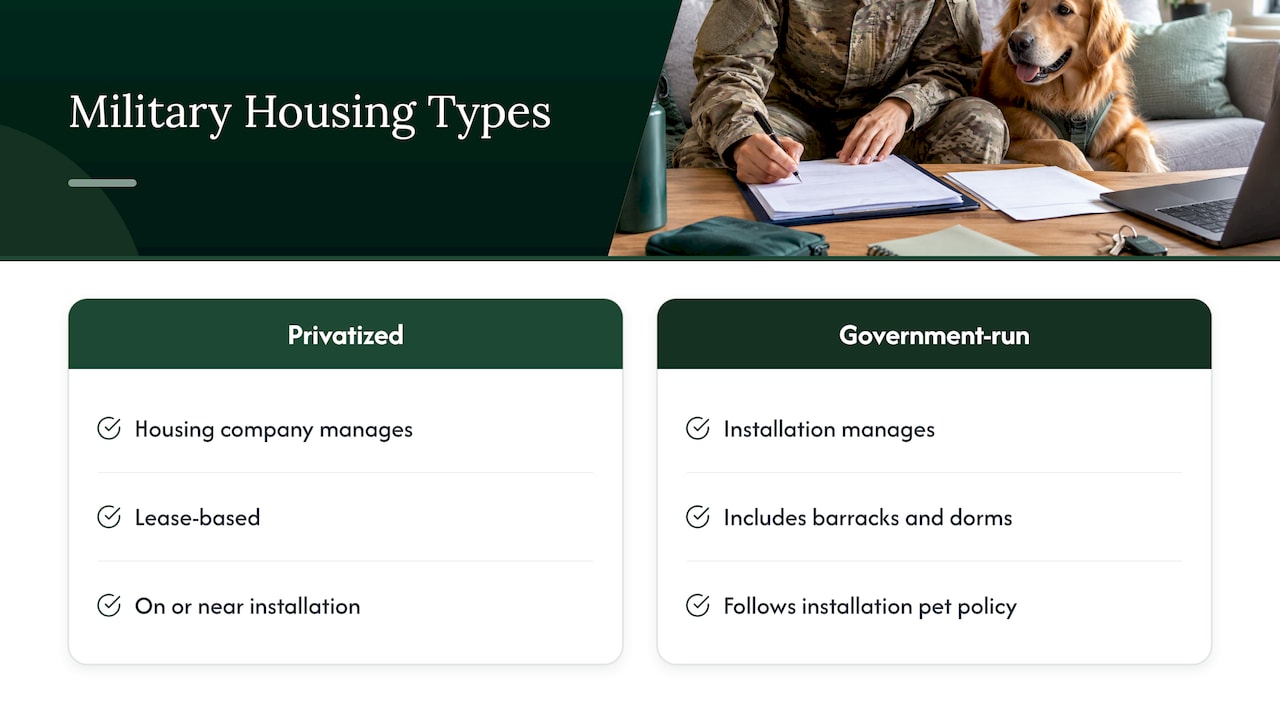
Military housing comes in two forms, and the difference shapes your request.
Privatized housing is run by a housing company under a lease, on or near an installation. Non-privatized (government-controlled) housing, along with barracks and dorms, is managed by the installation. Both follow the installation’s pet policy, usually issued by the garrison commander.
The Department of Justice explains the legal backdrop. A service animal has a narrow definition: a dog of any breed or size trained to perform a task related to a person’s disability. “Assistance animal” is a broader term that can include emotional support animals, and the animal can be any species. The DOJ page says both are permitted in housing under the Fair Housing Act or Section 504.
Installation policies follow that split. Fort Huachuca’s policy says that under the Fair Housing Act, accommodations can be requested to allow access for emotional support animals. It also says that deciding whether a request is reasonable and appropriate is within the discretion of the installation’s authorities. Fort Belvoir’s September 2025 memo says the same about its Garrison Commander’s discretion.
So the honest answer is this: the law gives you a path to ask, and your installation’s written policy tells you how that path works.
ESA or service animal: why it matters on base
The label changes where your animal can go.
Fort Bliss defines a service animal as a dog trained to do a specific task for its owner. It describes an emotional support animal as a companion prescribed to someone with a disabling mental disability that needs no specific task training. Fort Huachuca goes further. Its policy says emotional support, therapy, comfort or companion animals do not qualify as service animals under the ADA, so they do not get the same access.
Fort Cavazos’s housing chief put it plainly in 2024. Per army.mil’s report on the policy, a service animal is trained for certain tasks. An ESA is treated as a pet that helps the person feel at ease because of a mental health condition.
In practice:
- At home, your ESA can be approved to live with you through a housing accommodation.
- Outside your home, such as in the commissary, offices or other facilities, an ESA does not carry the access rights of a service dog. Joint Base Anacostia-Bolling’s pet policy says assistance animals are not automatically permitted by law to accompany an owner to any facility.
If you are unsure which category fits your situation, our guide on ESA vs. service dog differences walks through the definitions and what each one allows.
Pet limits, breed rules and fees
Most of the practical friction comes from three things: how many animals you can keep, which breeds are barred, and what you pay. Here is how a few published installation policies handle them.
| Installation | Standard limit | What the policy says about assistance animals and ESAs |
|---|---|---|
| Fort Bliss (privatized) | Two dogs, two cats, or one dog and one cat | The housing company may waive the limit after weighing needs, neighbors, wear and tear and prior waivers. ESAs are excluded from breed restrictions under the FHA. |
| Fort Huachuca (privatized) | Two pets | The limit may be waived after weighing the resident’s and the animal’s needs, neighbors, wear and tear, prior waivers, and whether the animal is claimed as an assistance or emotional support animal. |
| Fort Belvoir (privatized) | Three animals total, including fish, guinea pigs, hamsters and birds | The owner, after consulting the Garrison Commander, may grant exceptions. ESA accommodation under the FHA is within the Garrison Commander’s discretion. |
Sources: Fort Bliss Policy Memorandum 24, Fort Huachuca FH 40-116 and Fort Belvoir Policy Memo 14.
Breed restrictions
Many installations bar certain breeds. Fort Bliss says pets that serve as assistance animals, which includes ESAs, are excluded from breed restrictions under the Fair Housing Act. Joint Base Anacostia-Bolling handles it as a waiver. Waivers for assistance animals of a prohibited breed may be issued by the installation group commander and the housing company, in line with the lease.
Behavior still counts. Fort Bliss says an ESA that violates installation access restrictions may be barred from the installation at the Garrison Commander’s direction. A well-behaved, vaccinated, leashed animal is the best protection for your accommodation.
Fees and deposits
Fort Belvoir’s memo says the privatized housing owner may charge animal-related fees, refundable and non-refundable, as stated in the lease. Fort Bliss says its housing company may set fees in its occupancy policy and lease. Outside the military, civil rights agencies state that assistance animals are not pets, so pet fees and deposits may not apply in the same way. Tenants remain responsible for damage and for keeping the animal from creating health or safety concerns.
Because military housing rules vary, ask the housing office in writing how fees apply to an approved assistance animal at your installation.
How to request approval, step by step
The exact route depends on your installation, but the process looks like this.
- Read your installation’s pet policy. Search your garrison’s site for the animal control or domestic animals policy. It names who decides and where to send requests.
- Get a letter from a licensed clinician. Fort Bliss requires a letter from a licensed mental health professional or medical doctor to classify the animal as an ESA. Our guide to getting an ESA letter the honest way explains what a legitimate evaluation looks like, and the ESA letter sample shows what a real letter contains.
- Send it to the right office. At Fort Bliss, privatized residents submit a copy through the housing community manager. Non-privatized residents use the Installation Safety Office. Elsewhere, start with the installation housing office.
- Prepare pet records. Patrick Family Housing’s application checklist asks for vet records showing breed and rabies vaccination, plus a photo of each pet. Gather the same for your animal, whatever your location.
- Ask for the decision in writing. Keep copies of everything you send and receive, with dates.
What can a housing provider ask for? HUD’s 2020 notice says providers may confirm, when the disability is not apparent, that the accommodation is needed because of a disability and is reasonable. Expect to document the disability-related need, not to hand over your full medical file.
A word on registries. Online “registrations,” ID cards and certificates are not what housing offices look for. Our explainer on ESA registration and whether it is real covers why a clinician’s letter matters and a registry number does not.
What HUD’s 2026 change means for service members
In May 2026 HUD’s Office of Fair Housing and Equal Opportunity withdrew its 2020 guidance on assistance animals. According to a report on the HUD memo, staff were told to stop pursuing complaints from tenants whose animals have not been individually trained to perform disability-related tasks. A summary from a Florida association law update adds a key point: withdrawing guidance is not the same as amending the statute, and Congress has not amended the Fair Housing Act.
What does that mean for you?
- The law’s text is the same. The change is about what HUD says it will prioritize when it enforces.
- Military housing already worked mostly through installation policy and commander discretion, so your request still goes through the same office.
- Privatized housing companies and garrisons may update their policies. Check for the current version before you apply, and cite the Fair Housing Act in your request.
- Other routes may remain open, including state and local fair housing laws and private legal action. A legal assistance attorney can tell you which apply to you.
We track this in our guide to ESA housing rights after HUD’s change, and our state-by-state ESA letter laws page helps if your housing is off base and subject to state rules.
If your request is denied or delayed
Do not simply give up the animal or accept a silent “no.”
- Ask for the reason in writing. A denial tied to a specific policy, an incomplete document or a behavior concern is something you can fix. A vague refusal is something you can escalate.
- Contact a Military Tenant Advocate or a legal assistance attorney. The Fort Belvoir Installation Housing Office briefing says residents can reach a Military Tenant Advocate or legal assistance attorney through the housing office. They can help you prepare a request to start dispute resolution. Other installations publish similar briefings.
- Go up the chain. Since Garrison Commanders hold discretion in many policies, a clear, polite written appeal with your clinician’s letter is a normal next step.
- Keep your timeline. Dates of your request, follow-ups and responses matter if the matter goes to dispute resolution.
If you are moving off base, the picture changes. Landlords in the civilian market follow federal, state and local housing law, and some states have their own protections. Check your state’s rules first.
Our perspective
Most service members who ask us about an ESA are not looking for a loophole. They have a hard move ahead, a new duty station, a deployment cycle or a mental health condition that gets worse when they are alone, and they want to keep the animal that helps them cope.
We think the best preparation is boring and honest. Read your installation’s policy. Get a real letter from a licensed clinician who has evaluated you. Put your request in writing and keep the records. Online certificates and ID cards sell confidence they cannot deliver, and a housing office will not treat them as medical documentation.
We also think you should hear plainly that an ESA is not a service animal. That is not a reason to feel discouraged. It tells you what to ask for: a housing accommodation, made on documented need, with a well-behaved animal.
Our work is free information so you can walk into that office knowing the rules, and not be at the mercy of whoever has a form to sell you.
Erik
Start with the right guide
If you are ready to move, we have free guides for each step. Begin with how to get an ESA letter, which covers what a licensed clinician evaluation involves and how to spot scams.
Then use our ESA letter sample to check that your letter has the elements a housing office expects. For a wider view of your rights, our Supportpet home page collects every guide in one place. We do not sell letters or registrations.
FAQ
Can the military force me to give up my pet if I have to live in housing that doesn’t accept pets?
It depends on the housing type and the policy. Privatized housing and installations set pet rules, and an approved assistance animal may be granted a waiver. If you believe you need your animal because of a disability, submit a written accommodation request with a clinician’s letter before you move.
Do ESAs count toward the pet limit in military housing?
They can. Fort Bliss and Fort Huachuca set standard limits on dogs and cats, and each lets the housing company or authority waive the limit. Both consider whether an animal is claimed as an assistance or emotional support animal when deciding. Ask the housing office whether your ESA counts and request a waiver in writing if needed.
Can my ESA go with me into other buildings on base?
Not as of right. Installation policies such as Fort Huachuca’s say ESAs do not qualify as service animals and do not receive the same access. Your accommodation covers housing. For access elsewhere, you need permission from the facility, or a trained service animal.
Do I need a specific form or an ESA registration?
You need a letter from a licensed mental health professional or medical doctor, per the Fort Bliss policy, and any local forms your housing office uses. A paid online registry or ID card is not a substitute.
Is an ESA still protected after HUD’s 2026 change?
The Fair Housing Act has not been amended, so the statute still applies. HUD’s enforcement priorities shifted, which may make complaints harder to pursue through HUD. See our housing rights guide for the latest.
Sources
- Servicemembers and Veterans Initiative: Service Animals and Assistance Animals (U.S. Department of Justice)
- Fort Huachuca FH 40-116: Control and Care of Pets, Horses, and Transient Animals
- Fort Belvoir Policy Memo 14: Domestic Animals
- Fort Bliss Policy Memorandum 24: Animal Control Policy
- Fort Cavazos unveils new domestic pet policy (army.mil)
- Emotional Support Animals vs. Service Animals (Indiana Civil Rights Commission)
- HUD guidance on reasonable accommodations, 2020 (HUD Archives)
- Patrick Family Housing application checklist
- Installation Housing Office Plain Language Briefing (Fort Belvoir)
- HUD memo ends housing protections for emotional support animals (IBTimes UK)
- Rembaum’s Association Roundup: HUD’s withdrawal of emotional support animal guidance (FCAP Group)
Recommended
- Emotional Support Animals & ESA Letters: Your Rights Guide
- ESA Housing Rights in 2026: What HUD’s Change Means
- Emotional Support Cats: How a Cat Becomes an ESA (2026)
- ESA vs. Service Dog: Key Differences in 2026